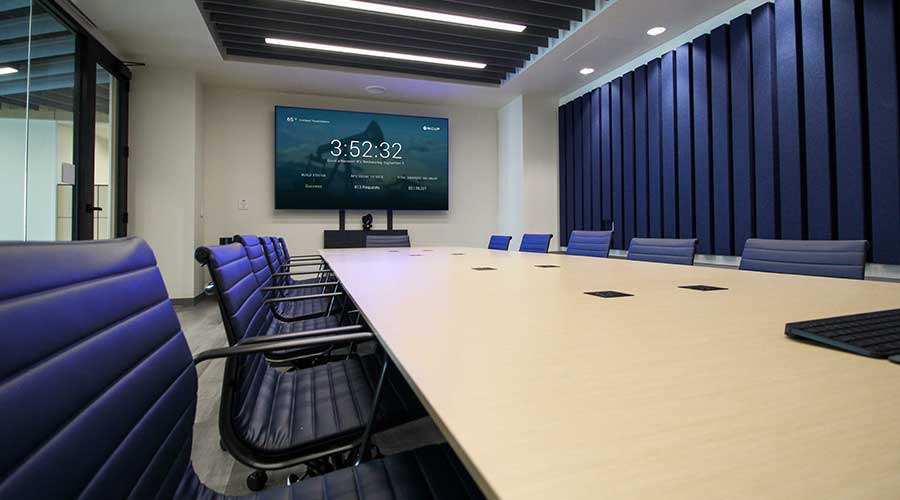
AV Technical Debt: Why Aging AV Systems Cost More Than You Think
The real cost of a failed meeting room is not the equipment, it is the time lost when work stops.
A 30-minute executive call delayed by 10 minutes across 12 participants is already two hours of wasted labor. Multiply that across a week of recurring issues, and most organizations are quietly losing entire workdays to “minor” AV problems.
And yet the room still “works.”
This is the core problem with AV technical debt: it stays invisible until it becomes expensive.
The display turns on most of the time. Employees know which cable to unplug when the system freezes. IT keeps a few discontinued parts in a closet. One room uses Teams, another uses Zoom, and a third requires hunting for the right remote before a meeting can start.
Individually, these issues rarely trigger an upgrade. Together, they create a growing operational burden that compounds over time.
This is AV technical debt.
Like technical debt in software and IT infrastructure, AV technical debt builds when short-term fixes, delayed upgrades, inconsistent designs, and aging equipment make workplace technology harder and more expensive to operate.
The cost is not just replacement. It shows up every week as wasted time, avoidable support effort, unpredictable spending, and preventable risk.
Most organizations are not underinvesting in AV, they are overpaying to maintain systems that no longer perform at a business standard.
The goal is not to replace every system. It is to understand where technical debt exists, what it is costing, and which systems create the greatest business risk.
What Is AV Technical Debt?
AV technical debt is the accumulated operational, financial, and technical burden created by outdated, inconsistent, poorly documented, or difficult-to-support audiovisual systems.
In practical terms, it is the gap between:
- what a room should cost to operate, and
- what it actually costs in time, labor, disruption, and reactive spending.
It behaves like financial interest. The longer it is ignored, the more expensive it becomes to maintain.
It commonly develops when organizations:
- Extend equipment beyond its lifecycle
- Complete one-off room upgrades without standards
- Run multiple generations of technology in similar spaces
- Operate unsupported products
- Delay firmware or software updates
- Rely on undocumented custom programming
- Replace components without checking compatibility
- Allow temporary fixes to become permanent
- Build rooms without long-term support planning
- Inherit mixed platforms through acquisitions
These are not always poor decisions. Budgets shift, timelines compress, and temporary fixes are sometimes necessary.
Technical debt forms when those decisions accumulate without a plan to manage long-term impact.
What Does AV Technical Debt Look Like?
AV technical debt rarely appears as a single budget line. It shows up as recurring operational friction that only becomes visible when something fails.
And that is the key issue: AV debt is invisible until it is not.
Employees avoid unreliable rooms. IT repeats the same troubleshooting tasks. Facilities support systems they cannot fully monitor. Project teams discover hidden dependencies in cabling, programming, or infrastructure.
Common warning signs include:
- Similar rooms behave differently
- No remote visibility into devices
- Hard-to-source replacement parts
- Workarounds and handwritten instructions
- Missing or outdated documentation
- Mixed software and firmware versions
- Frequent meeting delays or support calls
- No defined refresh cycle
- One-off repair approvals without lifecycle context
- Only a few people understand critical systems
- Unexpected issues during upgrades
- Decentralized technology decisions
One issue is manageable. A pattern across rooms or locations signals systemic risk.
At that point, the organization is no longer dealing with isolated failures, it is maintaining an unmanaged AV environment.
The Business Cost of Aging AV Systems
Executives rarely evaluate AV in terms of technology. They evaluate it in terms of:
- time
- predictability
- risk
- and operational continuity
From that perspective, AV technical debt creates three primary cost centers:
1. Support burden (visible cost, but underestimated)
Aging systems often survive only through constant intervention.
A reboot here, a missing adapter there, another support ticket, another room swap. Individually small, collectively expensive.
The real cost is not the ticket, it is the interruption of higher-value work to resolve it.
If IT is repeatedly pulled into meeting room issues, those systems are effectively consuming engineering capacity that should be focused elsewhere.
If routine meetings require repeated assistance, the organization is maintaining a fragile system instead of operating a reliable one.
2. Lost productivity (largest hidden cost)
This is typically the most significant impact, and the least measured.
When a meeting starts late, participants do not “pause work.” They lose time across multiple roles, departments, and decisions.
More importantly, employees begin to change behavior:
- avoiding certain rooms
- defaulting to personal devices
- scheduling extra buffer time
- reducing in-person collaboration
- skipping rooms entirely
This creates a silent productivity tax: capacity exists, but it is not usable at scale.
Over time, organizations often discover they have enough rooms, but not enough trusted rooms.
3. Unpredictability and risk (highest executive concern)
This is where AV technical debt becomes a leadership issue.
Reactive replacement introduces uncertainty:
- unknown compatibility issues
- emergency procurement costs
- unplanned construction or cabling changes
- compressed timelines
- limited vendor options
- rushed design decisions
A single device failure can escalate into a multi-team project.
And because AV is often embedded in construction, IT, and facilities workflows, the risk is not isolated, it cascades.
In high-visibility spaces (executive rooms, boardrooms, operations centers, public venues), the cost of failure is not just financial, it is reputational.
Secondary but important: security and supportability gaps
Modern AV systems are networked endpoints.
When they are not properly managed, organizations lose visibility into:
- firmware status
- access control
- device inventory
- update cycles
- network exposure
Older systems may also fall outside current IT security standards or manufacturer support windows.
This is not just an IT concern, it is an enterprise risk management issue.
Why AV Technical Debt Is Often Missed
Most organizations evaluate AV systems using a binary lens:
Does it work?
If the answer is yes, the system is considered acceptable.
But AV performance is not binary. It is operational.
A room can “work” while still:
- wasting time every day
- requiring frequent intervention
- delivering inconsistent experiences
- increasing support load
- creating hidden project risk
Uptime alone does not reflect business impact.
The real indicators of technical debt are:
- how often support is needed
- how long issues take to resolve
- how many rooms are avoided
- how predictable meeting start times are
- how consistent user experience is across locations
- how much effort is required to maintain “normal operation”
If those metrics are not being tracked, technical debt remains invisible by default.
Building the Business Case for Modernization
Technical teams often recognize AV debt early. The challenge is translating it into executive decision language.
A strong business case does not start with equipment age. It starts with impact:
- What business functions depend on these rooms?
- How often do failures interrupt work?
- What is the internal cost of support time?
- What happens when a critical room fails?
- What is the cost of unpredictability?
- What risks increase if nothing changes?
Executives do not fund “better AV.”
They fund:
- reduced operational friction
- improved predictability
- lower support burden
- reduced risk exposure
- and more efficient use of space and time
The strongest cases quantify AV as a business system, not a facilities asset.
Reducing AV Technical Debt Without Full Replacement
Most organizations do not need a full rip-and-replace strategy. They need control, visibility, and prioritization.
A structured approach works best.
1. Build a complete AV asset inventory
You cannot manage what you cannot see.
Document:
- model and manufacturer
- installation date
- firmware/software version
- support status
- room function
- network connectivity
- documentation availability
- known issues
- lifecycle stage
This is the foundation for every other decision.
2. Apply a room criticality model (decision framework)
Not all rooms carry equal business weight.
A simple but effective model:
Tier 1 – Mission Critical
Executive rooms, boardrooms, operations centers, public-facing spaces
→ highest priority, lowest tolerance for failure
Tier 2 – High Usage
Standard conference rooms, training rooms
→ frequent use, moderate tolerance for disruption
Tier 3 – Flexible / Low Impact
Huddle rooms, overflow spaces
→ lower impact, higher tolerance for variability
Then evaluate each room using a simple scoring model:
- Business criticality (1–5)
- Failure frequency (1–5)
- Support burden (1–5)
- Replacement risk (1–5)
- User avoidance behavior (1–5)
Rooms above a defined threshold become modernization candidates.
This turns subjective frustration into a structured investment plan.
3. Separate “repairable” from “structurally obsolete”
Not every issue requires replacement.
But repeated fixes to the same system usually indicate structural debt.
A useful rule:
- If a system requires repeated intervention within a 6–12 month window, it is no longer a repair problem, it is a lifecycle problem.
4. Standardize room types (not just equipment)
Standardization is not about identical rooms, it is about predictable behavior.
Define:
- control experience
- collaboration platforms
- connectivity standards
- monitoring capability
- support model
- approved device sets
- documentation requirements
Consistency reduces long-term support cost more than any single hardware decision.
5. Build a multiyear AV lifecycle roadmap
A roadmap turns reactive spending into planned investment.
It should include:
- prioritized room tiers
- replacement timing windows
- budget forecasting ranges
- infrastructure dependencies (IT, power, construction)
- standardization targets
- risk mitigation steps
- ownership and governance model
This is where AV shifts from “break/fix” to managed infrastructure.
Key Questions for AV Lifecycle Planning
- Which rooms create the most operational disruption?
- Where do failures have the highest business impact?
- What systems are no longer supportable?
- Where is AV behavior inconsistent across locations?
- What percentage of meetings require intervention?
- Can we monitor and manage systems remotely?
- What risks exist if a critical room fails tomorrow?
- Are we planning replacements or reacting to failures?
- What projects will be impacted by existing AV conditions?
- Who owns AV standards and lifecycle governance?
If these questions are difficult to answer, technical debt is already present.
A More Strategic Approach
AV modernization should not begin with:
“What should we buy?”
It should begin with:
- Where is friction occurring?
- What is it costing us in time and predictability?
- Which systems are no longer aligned with business needs?
- What risk are we carrying by doing nothing?
- How do we create consistency at scale?
Organizations that treat AV as a connected operational system, not isolated room technology, gain:
- more predictable budgets
- fewer emergency projects
- lower support burden
- and more reliable collaboration environments
Once AV technical debt is visible, it becomes manageable. Until then, it compounds silently.
Frequently Asked Questions
How long should AV systems last?
There is no fixed lifecycle. Replacement should be based on supportability, reliability, security, and business impact, not age alone.
Do outdated systems need immediate replacement?
Not always. Prioritize based on risk, failure impact, and support cost.
What is the first step in modernization?
Start with discovery: inventory systems, assess condition, and identify critical rooms.
How does standardization reduce cost?
It reduces variation, simplifies support, improves training, and lowers long-term maintenance burden.
How should upgrades be prioritized?
By business impact, failure risk, support burden, and operational dependency, not equipment age.
Who should own AV lifecycle planning?
Typically IT, facilities, and operations jointly, with clear governance over standards and roadmap execution.
Turn AV Technical Debt Into a Managed Plan
If your organization is experiencing inconsistent room performance, rising support demand, or unpredictable AV costs, the first step is not replacement, it is visibility.
Level 3 Audiovisual helps organizations conduct structured AV environment assessments, identify room-by-room risk, and build phased lifecycle roadmaps aligned with business priorities.
You do not need to fix everything at once. You need a clear understanding of what is costing you the most and a plan to address it in the right order.
Contact Level 3 Audiovisual to schedule an AV environment assessment and begin turning technical debt into a managed lifecycle strategy.

