From Immersive Collaboration to Smarter AV Management: What Changed in AV Since Last InfoComm?
A Level 3 Audiovisual perspective on where workplace technology is heading next
A year can change a lot in workplace technology.
Last year, AV conversations focused heavily on new technology: smarter cameras, AI-enabled meeting features, flexible workspaces, and collaboration tools designed to support hybrid work. Those conversations still matter, but the bigger question has changed.
This year, organizations are asking a different question: how does the technology perform once it’s deployed?
Can it improve the experience for people in the room and those joining remotely? Can IT support it efficiently? Can facilities maintain it? Can leadership measure whether it delivered meaningful business value?
At Level 3 Audiovisual, that’s the lens we’re using as we look at what has changed since last InfoComm. While innovation continues to move quickly, we’re seeing organizations place greater emphasis on outcomes, consistency, and long-term manageability. The most successful AV solutions today are not necessarily the newest—they’re the ones that solve real business challenges, reduce friction, and support broader workplace technology strategies.
Two solutions that illustrate this shift are Google Beam and Innomesh by Innomate. While they address different challenges, both reflect a larger trend in enterprise AV: creating better user experiences while giving organizations greater visibility into the performance and lifecycle of their AV systems.
What Has Changed in AV Since Last InfoComm?
Three major shifts stand out:
- Organizations are prioritizing business outcomes over product specifications.
- Immersive collaboration technologies are redefining high-value remote interactions.
- AV management is becoming more proactive through monitoring, analytics, and lifecycle planning.
These shifts are influencing how organizations evaluate audiovisual technology investments, design meeting room technology, and build long-term workplace collaboration strategies.
The AV Conversation Has Shifted From Products to Outcomes
For years, AV planning often started with the room. What display should go on the wall? What camera should we use? Which microphone provides the best coverage? Which control system makes the room easier to operate?
Those decisions still matter, but they no longer drive the conversation.
The organizations we work with are thinking beyond individual devices. They’re asking how meeting rooms, training spaces, executive briefing centers, digital signage, unified communications platforms, scheduling tools, AV monitoring systems, and support workflows fit together. They want AV integration strategies that support business goals while creating a consistent experience for employees, clients, and guests.
It’s a significant shift because AV is no longer just a collection of rooms—it is becoming part of the broader workplace technology ecosystem.
This is especially true as AI, automation, immersive collaboration, and cloud-based AV management tools become more common. These capabilities can create better experiences, but only when they’re implemented with purpose. A smart camera in a poorly designed room still creates frustration. A powerful collaboration platform without standards still feels inconsistent. A connected AV environment without visibility remains difficult to support.
One mistake we frequently see is organizations investing in individual technologies without first defining the outcome they’re trying to achieve.
The better question is: what business challenge are we solving?
Is the goal to improve hybrid collaboration? Reduce support tickets? Standardize conference room technology across locations? Improve executive communications? Gain better data for future planning?
When those outcomes are clear, technology decisions become much easier to evaluate.
Some Conversations Deserve More Than a Standard Video Call
One of the reasons we’re excited about Google Beam is because it challenges a familiar assumption: that remote collaboration technology has to feel flat.
Most organizations have spent years trying to make hybrid meetings functional. Can everyone hear clearly? Can everyone see each other? Can the meeting start without technical issues? Those fundamentals remain essential, and many organizations are still working to improve them.
Yet not every meeting has the same stakes.
A leadership discussion between regional teams. A high-value client presentation. A board-level conversation. A specialist consultation. Any interaction where trust, focus, body language, and nuance directly influence the outcome.
These are the types of scenarios where immersive collaboration deserves serious consideration.
From our perspective, Google Beam is not a replacement for every meeting room. It fits best in environments where the quality of interaction has a measurable impact on business outcomes. Depending on the organization, that could mean executive briefing spaces, healthcare environments, educational institutions, legal settings, financial services, or client-facing collaboration spaces.
That’s why Google Beam stands out to us.
Rather than simply improving video conferencing, it encourages organizations to rethink how they approach high-value remote interactions. Instead of asking how to make remote meetings acceptable, it explores how certain conversations can feel more natural, focused, and human.
The distinction is important because the future of hybrid workplace technology isn’t about making every room premium. It’s about identifying where enhanced collaboration experiences create meaningful value and designing those spaces intentionally.
AV Management Needs to Become More Proactive
While collaboration experiences get most of the attention, operational visibility may have an even greater impact on long-term success.
As enterprise AV systems become more connected, AV environments are becoming harder to manage reactively. Waiting for equipment failures, user complaints, or executive meeting disruptions is no longer a sustainable support model.
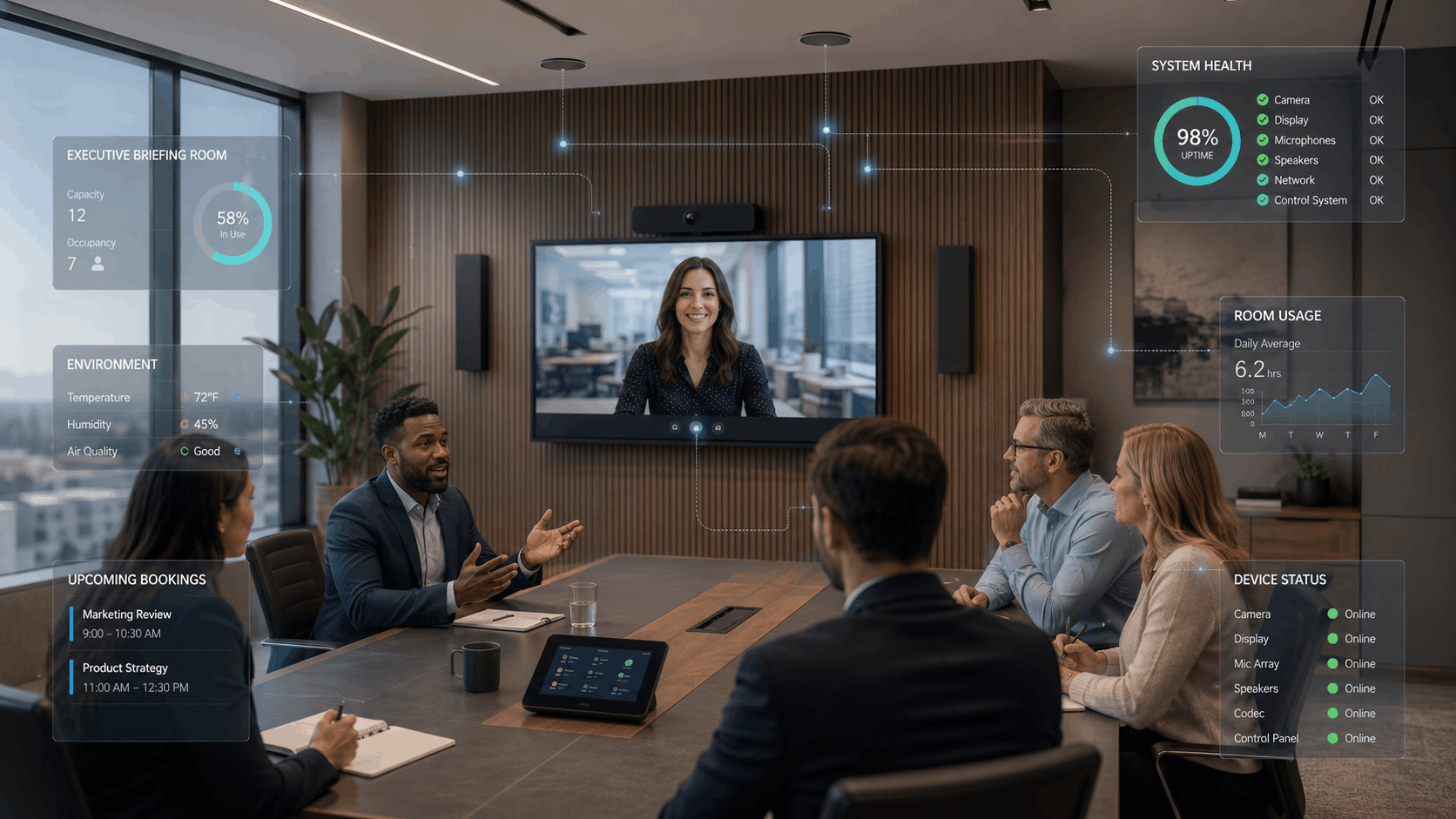
What we’re seeing among our clients is a growing demand for visibility into system performance, asset health, room utilization, and support trends. Organizations want to move beyond troubleshooting and toward proactive AV lifecycle management.
Many organizations still struggle to answer basic questions about their AV environment:
- Which rooms are used most often?
- Which devices generate the most support requests?
- Which AV systems are approaching end-of-life?
- Which rooms experience recurring issues?
- Which spaces are underutilized?
- Which upgrades should be prioritized?
- Which technology investments are delivering measurable value?
Without that visibility, AV decisions become reactive. Support teams spend more time troubleshooting. Facilities teams hear more complaints. IT teams inherit disconnected systems. Leadership has less confidence in future investment decisions.
This is one reason we’re excited about tools like Innomesh by Innomate. It aligns with where AV monitoring and AV asset management are heading: away from reactive support and toward a more proactive, data-driven approach.
Innomesh helps organizations look beyond what’s installed in a room and focus on how systems are actually performing. Teams can identify trends, monitor system health, understand usage patterns, and make more informed decisions about upgrades and support resources.
In our experience, organizations often underestimate how much operational visibility influences the overall success of their AV investments.
Better AV management leads to reduced downtime, more efficient AV support, smarter budgeting, and stronger long-term planning.
The future of enterprise AV management will rely less on guesswork and more on actionable data.
AV Is Becoming an Ecosystem, Not a Collection of Rooms
One of the biggest changes we’re seeing is that AV can no longer be planned room by room without considering the broader environment.
A meeting room may perform well on day one, but if it cannot be monitored, supported, updated, secured, or integrated into organizational standards, its long-term value begins to decline.
This is where audiovisual technology increasingly overlaps with IT strategy.
Network readiness matters. Security matters. Interoperability matters. Documentation matters. User adoption matters. Lifecycle planning matters.
Our clients are experiencing this firsthand. A single conference room technology decision can affect support workflows, employee productivity, executive communications, user satisfaction, and operating costs across multiple locations.
That doesn’t mean every room should be identical.
A huddle room, training room, boardroom, classroom, and executive briefing center all serve different purposes. However, organizations benefit from consistency where it matters most:
- A familiar user experience
- Clear room standards
- Reliable audio and video performance
- Platforms aligned with collaboration goals
- Efficient support processes
- Scalable AV solutions across locations
- Data-driven planning and decision-making
This is the difference between installing AV equipment and building a workplace technology strategy.
Business Leaders Need a Roadmap, Not More One-Off Decisions
Budget pressure is another reason this shift matters.
Organizations continue to invest in audiovisual technology, workplace collaboration tools, and hybrid workplace technology, but purchasing decisions have become more deliberate. Leaders want to understand which investments create the greatest value, which systems require immediate attention, and which upgrades can wait.
What we’re seeing among the organizations getting the most value from their AV investments is a commitment to long-term planning rather than isolated purchases.
A strong roadmap helps organizations move away from reactive decisions and toward a phased strategy. It identifies which rooms are creating friction, which systems are becoming difficult to support, which spaces require enhanced collaboration experiences, and which investments will have the greatest operational impact.
The most effective workplace technology roadmaps answer questions such as:
- Which rooms are most critical to business operations?
- Where are users experiencing the most friction?
- Which systems create the greatest support burden?
- Which spaces require specialized collaboration experiences?
- Which technologies should be standardized?
- Which investments should happen now, next, and later?
- Which tools will improve decision-making over time?
Viewed through a strategic lens, solutions like Google Beam and Innomesh become tools for achieving specific business outcomes.
Google Beam expands what’s possible for immersive collaboration. Innomesh improves visibility into AV systems and operational performance.
Neither solution is valuable simply because it’s new. Their value comes from how effectively they support organizational goals.
Key Takeaways
- AV decisions are increasingly driven by business outcomes rather than individual products.
- Immersive collaboration technologies are creating new possibilities for high-value conversations.
- AV monitoring and operational visibility are becoming essential as AV systems grow more complex.
- Organizations benefit from a workplace technology roadmap rather than isolated technology purchases.
- Successful AV investments align with user experience, operational goals, support requirements, and long-term planning.
What Business Leaders Should Take Away Before This Year’s InfoComm
Innovation in audiovisual technology continues to accelerate. AI-enabled tools, immersive collaboration experiences, cloud-based AV management platforms, and smarter meeting room technology will continue to reshape workplace expectations.
The challenge isn’t finding new technology. It’s determining which technologies deserve attention and investment.
At Level 3 Audiovisual, we believe the most productive conversations focus on fit, purpose, and measurable value. Which experiences matter most? Which spaces require a higher level of performance? Which systems need greater visibility? Which investments will reduce friction for users and support teams alike?
The organizations that gain the most value from the next generation of AV solutions will be the ones that ask better questions before they buy. They’ll understand the difference between impressive features and meaningful improvements. They’ll know where immersive experiences make sense, where proactive management is needed, and where a strategic roadmap can prevent unnecessary spending.
Those are the conversations we’re looking forward to having this year. If you’re evaluating collaboration technology, planning future AV investments, or looking for ways to improve visibility across your AV environment, connect with the Level 3 Audiovisual team. We’d be happy to discuss your goals and help you build a strategy that supports both today’s needs and tomorrow’s opportunities.
Frequently Asked Questions About AV Trends in 2026
What is the biggest trend in audiovisual technology today?
The biggest trend is the shift from product-focused AV decisions to outcome-focused workplace technology strategies. Organizations are prioritizing collaboration experiences, operational visibility, user adoption, and measurable business value.
What is Google Beam used for?
Google Beam is designed for immersive remote collaboration experiences where presence, eye contact, body language, and natural interaction can improve communication outcomes. It is best suited for high-value conversations where engagement and connection matter.
Why is AV monitoring important?
AV monitoring helps organizations identify issues before users experience them, reduce downtime, improve support efficiency, optimize room performance, and make more informed technology investment decisions.
What is AV lifecycle management?
AV lifecycle management is the process of tracking, maintaining, upgrading, and replacing AV systems based on performance, usage, support requirements, and business needs.
What is the difference between AV integration and AV management?
AV integration focuses on designing and deploying AV solutions, while AV management focuses on monitoring, maintaining, supporting, and optimizing those systems throughout their lifecycle.
How can organizations improve hybrid collaboration?
Organizations can improve hybrid collaboration by standardizing meeting room technology, prioritizing user experience, investing in reliable AV solutions, and ensuring collaboration tools align with broader business objectives and workplace technology strategies.

